 ITA
ITA
 DEU
DEU
 FRA
FRA
 ESP
ESP





Novablast, Superblast, Megablast, Cumulus, Kayano, Magic Speed, Metaspeed. If you’ve ever opened the ASICS page of any running store and got lost among the names, you’re not alone: it’s the question we hear most often in our shop. Lorenzo, from our team, summed it up like this in a video shot between one delivery and the next: “How many models does ASICS have? A lot, I can confirm. Let’s clear things up a bit.”
In this guide we take his framework and expand on it: three areas, a clear role for each shoe, and a simple way to work out which one is right for you.
In short
- The ASICS road range is easier to understand when split into three areas: daily trainers (your everyday shoes), the Blast family (responsive shoes for livelier sessions) and racing (carbon-plated shoes).
- Stability daily trainers: Gel-Kayano 33 and GT-2000 15, for runners who need support. Neutral daily trainers: Gel-Nimbus 28 and Gel-Cumulus 28.
- Blast family: Novablast 6 (the most versatile), Superblast 3 (more propulsion, more protection), Megablast (a racer without a plate), Sonicblast 2 (with a plate, but not carbon).
- Racing: Magic Speed 5 (carbon, also for training) and Metaspeed (the top competition shoe).
- If you’re just starting out or mostly run easy, start with a daily trainer. If you want one shoe that does a bit of everything, look at the Novablast 6.
Contents
- Why ASICS has so many models
- ASICS technologies in two minutes
- Area 1: daily trainers
- Area 2: the Blast family
- Area 3: racing shoes
- Comparison table
- Which ASICS to choose: five runner profiles
- Frequently asked questions
- Conclusion
Why ASICS has so many models
ASICS was founded in Kobe, Japan, in 1949, and its name comes from the Latin motto Anima Sana In Corpore Sano. Over more than seventy years it has built one of the widest running ranges on the market, and the reason is simple: there is no single shoe that suits everyone. Runner weight, foot strike, pace, weekly mileage and goals all change.
The problem is that, with the whole range on the same shelf, it looks like a maze. That’s why in our shop we split it into three areas:
- Daily trainers: shoes for piling on the miles, every day, at an easy or moderate pace.
- Blast family: the hardest category to label. As Lorenzo describes it, “something more than an everyday shoe, something more specific for a quality session”. These are the shoes for your livelier runs.
- Racing: carbon-plated shoes, built to go fast.
From here on, every model has its place.
ASICS technologies in two minutes
Before getting into the models, it’s worth knowing the acronyms you’ll find on every product page. They are the foams (FF stands for FlyteFoam) and the systems that set one shoe apart from another.
- FF BLAST MAX: the soft, protective foam of the latest daily trainers. You’ll find it in the Gel-Cumulus 28, GT-2000 15, Gel-Kayano 33 and in the heel of the Novablast 6.
- FF BLAST PLUS: firmer and more stable, often used as a base layer or as the main foam (Gel-Nimbus 28).
- FF TURBO² (Turbo Squared): a very responsive, race-derived foam. It’s the heart of the Megablast and Sonicblast 2, and forms the forefoot insert of the Novablast 6.
- FF LEAP: the lightest foam in the range, with the highest energy return. You’ll find it in the Superblast 3, Magic Speed 5 and Metaspeed.
- PureGEL: the evolution of the classic ASICS GEL, a heel insert that softens impact. It’s what gives the “Gel” prefix to the Nimbus, Cumulus and Kayano.
- Carbon plate: makes the shoe stiff and responsive at fast paces. It’s the trademark of the racing area.
A rule of thumb: the further you move from FF BLAST MAX towards FF LEAP, the lighter and more responsive the shoe becomes, and the less forgiving it is of untidy running form.
Area 1: daily trainers
These are the shoes that cover most of your mileage: easy runs, slow long runs, recovery. ASICS splits them into two groups, and the difference lies in foot strike.
- Stability: they help control a foot that tends to roll inwards (pronation), or runners who lose some control as fatigue sets in.
- Neutral: they don’t correct anything and let the foot do its work. Suitable for most runners with a regular foot strike.
Gel-Kayano 33: the benchmark stability shoe
The Kayano has been ASICS’s stability shoe par excellence for more than thirty years. With version 33 ASICS changed its approach: the 4D Guidance system makes way for the new FluidSupport, a support on the inner side of the heel that guides the foot without forcing it. The midsole is dual-layer, FF BLAST MAX on top and FF BLAST PLUS below, with an 8 mm drop.
Who it’s for: runners who need support and want maximum protection, medium to heavier runners, slow long runs and high weekly mileage. Who it’s not for: runners with a neutral foot strike looking for a light, lively shoe. Compared with the previous version the ride is more traditional and less “bouncy”.
-
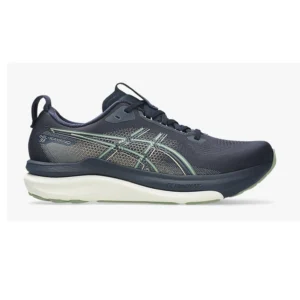
Gel Kayano 33 men
Original price was: 200,00€.179,00€Current price is: 179,00€. VAT included -
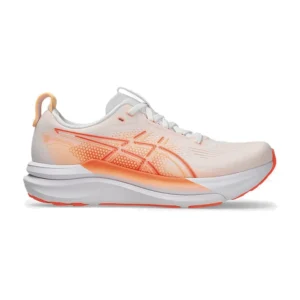
Gel Kayano 33 women
Price range: 179,00€ through 200,00€ VAT included
GT-2000 15: the lightweight stability shoe
Same mission as the Kayano, but in a lighter, more essential package. Full-length FF BLAST MAX midsole, 3D guidance system and an 8 mm drop. Version 15 is softer than its predecessor and has a redesigned heel area.
Who it’s for: runners looking for moderate support in a nimble shoe, including the odd run at a moderate pace. A great first stability shoe. Who it’s not for: runners who need a lot of support or a lot of cushioning: in that case step up to the Kayano. The fit is fairly snug, so try it on.
-
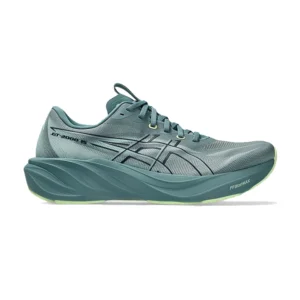
GT-2000 15 Men
150,00€ VAT included -
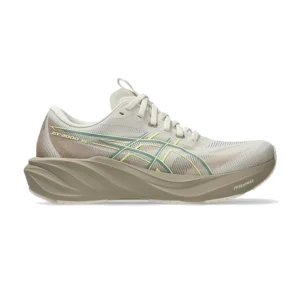
GT-2000 15 Women
150,00€ VAT included
Gel-Nimbus 28: the most protective neutral shoe
The Nimbus is ASICS’s “premium” neutral shoe: the highest and most protective of the neutral daily trainers. FF BLAST PLUS midsole with a PureGEL insert in the heel and an 8 mm drop. With version 28 ASICS made it the lightest Nimbus ever, thanks to a thinner knit upper.
Who it’s for: runners who log a lot of easy miles and want maximum protection in a neutral shoe, Sunday long runs, medium to heavier runners. Who it’s not for: anyone expecting an ultra-soft shoe: the feel is protective but firmer than its stack height suggests.
-
Gel-Nimbus 28 men
Price range: 137,00€ through 178,00€ VAT included -
Gel Nimbus 28 women
Price range: 137,00€ through 200,00€ VAT included


Gel-Cumulus 28: the do-it-all neutral shoe
If the Nimbus is the “saloon car”, the Cumulus is the compact that does everything well. FF BLAST MAX midsole with PureGEL in the heel, a stated 8 mm drop, and a more accessible price.
Who it’s for: new runners, anyone looking for a first serious shoe, runners doing 2-4 easy runs a week. It’s also an excellent second shoe for recovery runs. Who it’s not for: runners looking for responsiveness for fast sessions: that’s what the Blast family is for.
-
Gel Cumulus 28 men
Price range: 95,00€ through 150,00€ VAT included -
Gel Cumulus 28 women
Price range: 95,00€ through 135,00€ VAT included
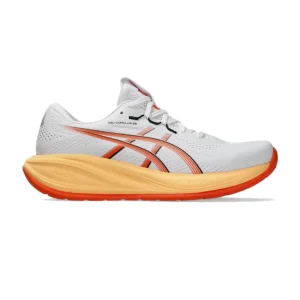
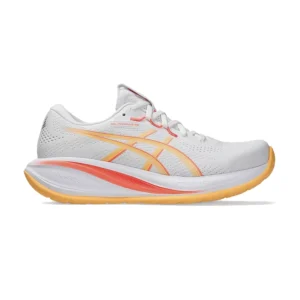
In one line: the Kayano and GT-2000 support you, the Nimbus and Cumulus leave you free. The Kayano and Nimbus protect more, the GT-2000 and Cumulus weigh less.
Area 2: the Blast family
This is where things get interesting. The Blasts are high-stack, very responsive shoes that sit halfway between a daily trainer and a racing shoe. They’re the ones that turn a tempo run or a progressive long run into a fun outing. In order of “propulsion”:
Novablast 6: the classic, the most versatile
The starting point of the family and, for many runners, the most complete ASICS shoe of all. Lorenzo calls it “the most classic, the most cushioned of the advanced daily trainers”. Version 6 has a new midsole: FF BLAST MAX in the heel and an FF TURBO² insert in the forefoot that boosts the bounce effect. 8 mm drop.
Who it’s for: runners who want one shoe for everything, from easy runs to tempo runs and even some intervals. Runners who find classic daily trainers too “flat”. Who it’s not for: runners who need support (it’s not a stability shoe) or who want maximum protection on very long runs.
-
Novablast 6 men
Price range: 144,00€ through 160,00€ VAT included -
Novablast 6 women
Price range: 144,00€ through 160,00€ VAT included
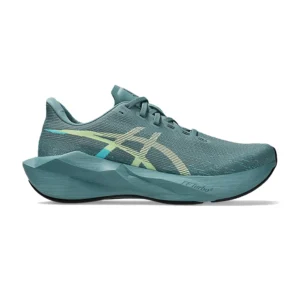
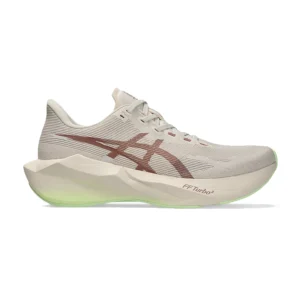
Superblast 3: one step up
In Lorenzo’s words, “one step further up in terms of propulsion”. Higher, and lighter for the amount of foam it carries, with a top layer of FF LEAP and a bottom layer of FF BLAST PLUS. No plate, 8 mm drop. Version 3 has a wider toe box and a smoother heel transition.
Who it’s for: runners training for a half or full marathon who want one shoe for long runs, tempo runs and pace work. Many also race in it. Who it’s not for: runners who only run easy (you wouldn’t make the most of it) or who prefer to feel the ground.
We covered it in depth in our Superblast 3 review.
-
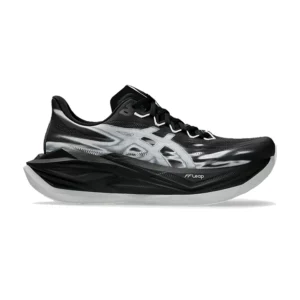
Superblast 3
220,00€ VAT included
Megablast: a racer, but without a plate
The Megablast is the answer for runners who want race performance without the stiffness of carbon. Midsole made entirely of FF TURBO², the most responsive foam in the family, and no plate. It’s remarkably light for its height. 8 mm drop.
Who it’s for: “runners who want a racing shoe without a plate”, as Lorenzo puts it. Great for races up to the marathon, long sessions at race pace and for runners who don’t get on with carbon. Who it’s not for: anyone looking for a budget everyday shoe: it’s an investment designed for the days that matter.
-
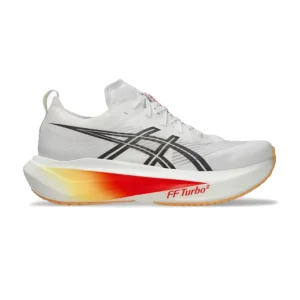
Megablast
240,00€ VAT included
Sonicblast 2: the Blast with a plate
The last in the family adds a plate, but not a carbon one: a more flexible plastic material that provides stability and a bit of propulsion without the stiffness of a racing shoe. Dual-layer midsole, FF TURBO² on top and FF BLAST MAX below, 8 mm drop. Version 2 has a more rounded heel and a new insert under the forefoot.
Who it’s for: runners who want a fast training shoe with the “guided” feel of a plate, but more forgiving than a Metaspeed. Who it’s not for: runners who mostly run easy or who simply want a soft shoe.
In one line: the Novablast is the everyday Blast, the Superblast the long-run one, the Megablast the carbon-free racer, the Sonicblast the one with the “gentle” plate.
Area 3: racing shoes
Here, as Lorenzo says, “there’s not much to add”: these are carbon-plated shoes built to go fast. ASICS offers two levels.
Magic Speed 5: carbon for training (and racing)
The gateway to ASICS carbon. Full-length carbon plate, midsole with FF LEAP on top and FF BLAST PLUS below, 7 mm drop. More stable and more durable than a pure racing shoe.
Who it’s for: runners who want to try carbon for the first time, or who are looking for a shoe for intervals, threshold sessions and races from 10K to the marathon. Who it’s not for: runners after the absolute lightness of race day: that’s what the Metaspeed is for.
-
Magic Speed 5
Price range: 137,00€ through 190,00€ VAT included
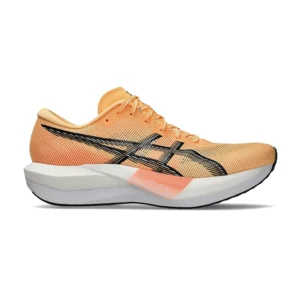
Metaspeed: the top of the range
ASICS’s competition line, with an FF LEAP midsole and a carbon plate. It comes in two versions, designed for two different running styles:
- Metaspeed Sky: for runners who increase speed by lengthening their stride. Flatter plate.
- Metaspeed Edge: for runners who increase speed by increasing their step frequency (cadence). More curved plate.
Who it’s for: runners racing on the road with a time goal who are already familiar with carbon shoes. Who it’s not for: beginners, runners with an unstable foot strike or heel strikers: these are narrow, unforgiving shoes.
Comparison table
| Model | Area | Foot strike | Midsole | Plate | Drop | List price |
|---|---|---|---|---|---|---|
| Gel-Kayano 33 | Daily trainer | Stability | FF BLAST MAX + FF BLAST PLUS | No | 8 mm | €200.00 |
| GT-2000 15 | Daily trainer | Stability | FF BLAST MAX | No | 8 mm | €150.00 |
| Gel-Nimbus 28 | Daily trainer | Neutral | FF BLAST PLUS + PureGEL | No | 8 mm | €200.00 |
| Gel-Cumulus 28 | Daily trainer | Neutral | FF BLAST MAX + PureGEL | No | 8 mm | €150.00 |
| Novablast 6 | Blast | Neutral | FF BLAST MAX + FF TURBO² | No | 8 mm | €160.00 |
| Superblast 3 | Blast | Neutral | FF LEAP + FF BLAST PLUS | No | 8 mm | €220.00 |
| Megablast | Blast | Neutral | FF TURBO² | No | 8 mm | €240.00 |
| Sonicblast 2 | Blast | Neutral | FF TURBO² + FF BLAST MAX | Yes, not carbon | 8 mm | €190.00 |
| Magic Speed 5 | Racing | Neutral | FF LEAP + FF BLAST PLUS | Carbon | 7 mm | €190.00 |
| Metaspeed Sky / Edge | Racing | Neutral | FF LEAP | Carbon | Varies | See product page |
List prices on our website as of September 2026. Many models are often on sale: check the product page for the current price and available sizes.
Which ASICS to choose: five runner profiles
1. You’ve just started running. Start with a daily trainer. If your foot strike is regular, the Gel-Cumulus 28. If we see in store that your foot rolls inwards, the GT-2000 15. You don’t need anything more for the first few months.
2. You run 3-4 times a week, mostly at an easy pace. The Gel-Nimbus 28 if you’re neutral, the Gel-Kayano 33 if you need support. These are the shoes that protect you as the mileage goes up.
3. You want one shoe that does a bit of everything. The Novablast 6, no need to overthink it. It’s the most versatile in the range.
4. You’re training for a half or full marathon. A daily trainer for easy runs plus a Superblast 3 for long runs and pace work. For race day: the Megablast if carbon doesn’t convince you, the Magic Speed 5 if you want to try it.
5. You have a time goal and you’re already used to carbon. The Metaspeed, Sky or Edge depending on how you run. To train specifically without wearing them out, pair them with a Sonicblast 2 or a Magic Speed 5.
One piece of advice for everyone: two shoes with different roles last longer than a single shoe used for everything, and they help you run better.
Frequently asked questions
What’s the difference between the ASICS Gel-Nimbus and Gel-Kayano? Both are highly protective daily trainers, but the Nimbus is neutral, while the Kayano is a stability shoe: it has support on the inner side of the foot for runners who tend to overpronate.
What’s the difference between the Novablast and the Superblast? The Novablast 6 is the most versatile Blast, also suitable for everyday use. The Superblast 3 is higher and more responsive, with FF LEAP foam, and is designed mainly for long runs, pace work and racing.
Does the Megablast have a carbon plate? No. The Megablast is made entirely of FF TURBO² foam, with no plate. It’s designed for runners who want a racing shoe without the stiffness of carbon.
Which ASICS shoe should I choose to start running? A daily trainer: the Gel-Cumulus 28 if your foot strike is regular, the GT-2000 15 if you need a little support.
Metaspeed Sky or Metaspeed Edge? The Sky is designed for runners who increase speed by lengthening their stride, the Edge for those who increase their step frequency. If you’re not sure which one you are, a try-on in store helps you find out.
Do ASICS shoes run large or small? ASICS generally fits true to size, but each model has its own shape: racing shoes, for example, are narrower. Our advice is to try them on, or write to us before ordering online.
Conclusion
The ASICS range only seems complicated until you look at it by area: daily trainers for the miles, the Blast family to have fun and train better, racing shoes for the days when the clock matters. Within each area, the choice depends on how your foot lands and what you need.
You’ll find all the models on our ASICS shoes page, in men’s and women’s versions. If you’re torn between two models, come and see us in our stores in San Vendemiano or Pordenone, Italy: we’ll try them together. And if you’ve already run in them, tell us which ASICS is your favourite.