 ITA
 DEU
 FRA
 ESP




The difference between a vest that works with you and one that bounces on your shoulders is obvious within the first few kilometres. Knowing how to choose a trail running vest means looking beyond the stated capacity: what matters is the kind of outing, the mandatory kit, the way you drink and how it fits your body. A model that is too big for short trails carries useless weight; one that is too compact turns a long distance into a tricky juggling act of water, food and safety.
The vest (or race vest, or running backpack: they are the same thing) is one of the most personal pieces of a trail runner’s kit. It has to stay put when the trail drops away, let you grab a gel without breaking your rhythm and spread the load without chafing. Capacity is only the starting point.
At a glance
- Up to 4 litres for 1 to 1.5 hour runs and short races with frequent aid stations.
- 5-8 litres is the most versatile range: mountain training and trail races up to 25-30 km.
- 10-12 litres for long runs, races with an extended mandatory kit list and ultras.
- Try it loaded, with your own flasks and jacket: empty, almost every vest feels perfect.
How many litres you need: start from the distance
The first criterion is the real length of the outing, together with how self-sufficient you need to be. For a 60-90 minute session, perhaps a door-to-trail run on a route you know with fountains or water points, 2-4 litres is often enough: room for two soft flasks, phone, keys, gels and a light layer. It feels minimal, close to a technical top with pockets.
Between 10 and 25 km, or in the mountains where water is not guaranteed, a 5-8 litre vest is usually the most versatile compromise. It holds 1-1.5 litres of water, your food, a compact windproof or waterproof shell and the essentials for a change in the weather.
For long runs, trail races and distances beyond a half marathon, the choice moves towards 10-12 litres. That does not mean filling it to the brim every time: having spare volume lets you meet the race rules and adapt to cold, altitude and changing conditions. Beyond 12 litres you are into the territory of ultra trails, very remote routes, extended kit requirements or outings with big temperature swings.
The practical question is not “how many litres can I carry?” but “what do I need with me at the point furthest from the aid station or the car?”. That is where a sensible choice starts. Further down you will find the models we stock, grouped by capacity.
Water: soft flasks, a bladder or both?
The hydration system shapes the vest more than you might think. Two front soft flasks are the most immediate solution for many trail runners: you drink often, you can see how much water is left and you refill quickly at aid stations. The front pockets also hold gels, bars and salts, in other words everything you need while running.
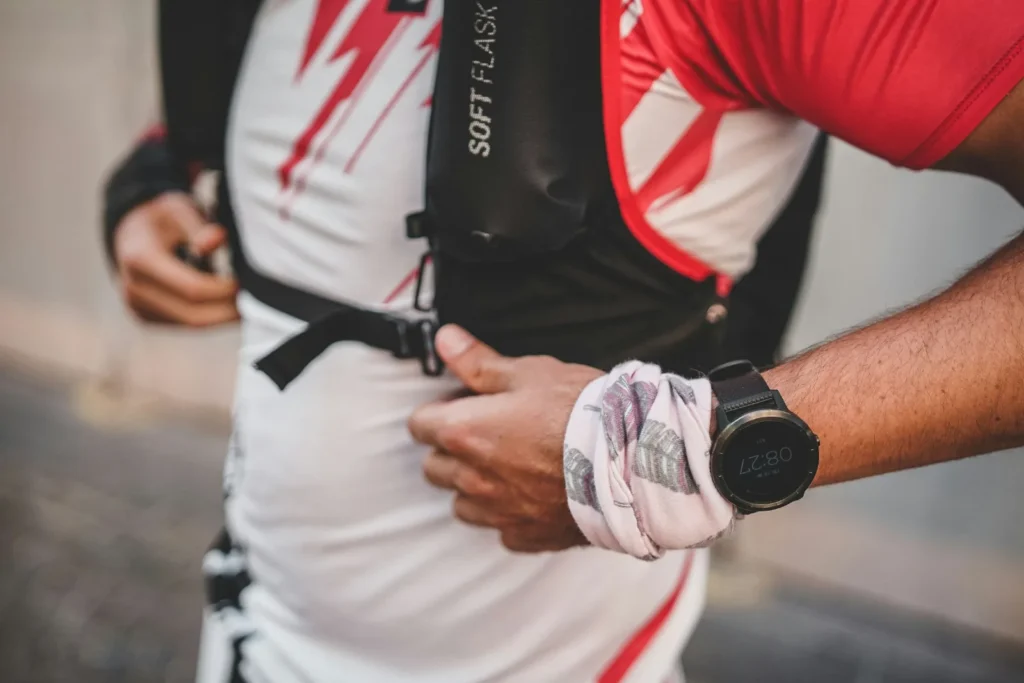
A bladder at the back offers more capacity and a more compact load on your back. It is useful on long stretches without water, but it needs a little more attention: the hose has to be well secured, a full bladder is slower to refill and it is not always easy to tell how much is left. In summer, the water on your back also warms up more easily.
A vest that works with both flasks and a bladder gives you more freedom. In a race with frequent aid stations two 500 ml flasks may be enough; on an exposed ridge or a long summer training session, a 1.5 litre bladder paired with a flask of electrolytes is an effective set-up. Habit counts too: runners who like small, frequent sips tend to prefer front flasks, while those who do not want to manage two containers lean towards the bladder.
Fit: the vest should disappear while you run
You cannot judge a good vest standing still in front of a mirror. It has to be adjusted and tested with the load you will really carry: empty, almost every model feels stable, but the behaviour changes with a litre of water, a jacket, a phone and food.

The right size wraps around your chest without restricting your breathing. The front closures should allow small adjustments and stay secure both uphill and downhill. If the vest bounces, check how it is packed before blaming the model: half-empty flasks, loose items and a badly distributed load all increase movement.
Pay attention to the armpits and neck as well. Seams, stiff edges and rough fabrics become annoying after two or three hours, especially in heat, sweat or rain. A men’s or women’s specific design can help, but it does not replace trying it on: shoulder width, chest size and posture make the difference.
One often overlooked detail is side adjustment. It keeps the vest snug as the volume inside goes down, for example after you have put on your jacket or eaten some of your food. On a long-distance model, this adaptability is worth more than a few grams less on the spec sheet.
Pockets and organisation: everything needs a place
Total volume matters, but it is the layout of the pockets that makes a vest practical on the run. The front pockets should take flasks, gels, salts, phone and small items you use without taking the vest off. A zipped pocket is useful for keys, documents or electronic devices.
At the back you need space for what you use less often: waterproof shell, thermal layer, head torch, first aid kit or bladder. External stretch pockets are handy for stashing a jacket on the move, but they do not replace a closed compartment when the weather is uncertain or the route is technical.
Before you buy, packing your kit for real is the most practical test. Depending on season, race and terrain, consider at least:
- water and energy food for the expected time out;
- a waterproof or windproof jacket and, if needed, a warm layer;
- a charged phone, ID, cash or a card, and a survival blanket;
- head torch, whistle, emergency kit and poles, when required.
Not every vest handles poles the same way. If you use them often, check that the attachment system is easy to reach and stable, without getting in the way of your back or pockets; alternatively there are quivers and pole holders you can pair with the vest. If you run without poles, this feature takes second place to the convenience of the front pockets.
Mandatory kit and weather conditions
In a race, the rules come before your preferences. A 5 litre vest can be perfect for a short summer trail, but not enough if the organisers require a large water reserve, a jacket with precise specifications, waterproof trousers, a second layer, gloves, a hat and a head torch (just scroll through the Lavaredo Ultra Trail mandatory equipment list to get the idea). The safest way to choose is to lay out your entire mandatory kit and check that it fits without squashing everything too much.

The same reasoning applies in training. In the mountains the weather changes fast (if you run in the Dolomites, check ARPAV’s Dolomiti Meteo forecast before heading out, it is also available in English) and a warm start does not guarantee a dry ridge or a wind-free return. The right vest gives you the capacity to be self-sufficient, not just to travel light.
Weight needs context
A light vest is nice, but the stated weight is not an absolute value. A model with tougher fabric, better structured pockets and effective adjustments can weigh a few grams more and tire you less over long distances, because it avoids bouncing and pressure points.
What matters most is the fully loaded weight. A litre of water weighs a kilo: cutting what you do not need is right, giving up what you need for safety, weather or race rules is not. The goal is a tidy, stable load, not an empty vest.
The trail running vests you will find at MioMio Run
We stock vests from Salomon, Raidlight, Nathan, The North Face, La Sportiva, NNormal and Kailas. We have grouped them by capacity, following the logic of this guide: start from the range that matches your outings, then choose on hydration and fit.
Up to 4 litres: short runs and fast races
Here the vest is little more than a second skin with pockets. The Salomon S/LAB Pulsar 3 is the most minimal: 3 litres and a stated 90 grams, designed for races and short runs. The Nathan VaporHowe 2.0 4L was developed to the specifications of ultrarunner Stephanie Howe, while the VaporZach 2.5L is the lightest race vest in the Vapor series. If you are after solid value for money, there are the Raidlight models: the men’s Activ Trail 3L, supplied with two 600 ml EazyFlasks, and the women’s Revolutiv Ultralight 3L.
-
S/LAB PULSAR 3
Original price was: 160,00€.144,00€Current price is: 144,00€. VAT included -
VaporHowe 2.0 4L
Original price was: 170,00€.95,00€Current price is: 95,00€. VAT included -
VaporZach 2.5 Liter Men’s Race Vest
Original price was: 129,95€.85,00€Current price is: 85,00€. VAT included -
Activ Trail 3 liter men
Original price was: 79,90€.60,00€Current price is: 60,00€. VAT included -
Revolutiv Ultralight 3 litres women
Original price was: 99,90€.78,00€Current price is: 78,00€. VAT included -
Vapor Speedster 2 Litres women
Original price was: 79,95€.64,00€Current price is: 64,00€. VAT included


5-8 litres: the most versatile range
This is the capacity we recommend most often in the shop, because it covers most mountain training and trail races up to the middle distance. The Salomon ADV Skin 5 is a benchmark in the category, designed for races up to about 60 km; the Active Skin 8 takes the same approach to 8 litres, with two 500 ml flasks included. The The North Face Summit Run Vest 5 and the La Sportiva Trail Vest 5L both come with two 500 ml soft flasks. Then there is the NNormal Race Vest, with more stable flask pockets, updated pole attachments and a waterproof rear compartment, and the Kailas Fuga Air 8 IV, with dial adjustment, 14 pockets and two 500 ml flasks. The range is completed by the men’s and women’s Raidlight Responsiv Vest 6 and the men’s Activ 6L.
-
Adv Skin 5L
Original price was: 140,00€.126,00€Current price is: 126,00€. VAT included -
Active Skin 8 l
Price range: 91,00€ through 104,00€ VAT included -
Summit run vest 5
Original price was: 150,00€.135,00€Current price is: 135,00€. VAT included -
Trail Vest 5 L
Original price was: 120,00€.108,00€Current price is: 108,00€. VAT included -

Race Vest
135,00€ VAT included -
Fuga Air 8 IV
Original price was: 165,00€.156,00€Current price is: 156,00€. VAT included -
Responsiv Vest 6 litri men
Original price was: 130,00€.91,00€Current price is: 91,00€. VAT included -
Responsiv Vest 6 litri women
Original price was: 130,00€.91,00€Current price is: 91,00€. VAT included -
Activ Trail 6 liter men
Original price was: 99,90€.82,00€Current price is: 82,00€. VAT included


10-12 litres: long runs, long races and ultras
When the rules call for a jacket, waterproof trousers, a warm layer and a head torch, you need volume and a structure that stays put even when fully loaded. From Salomon, the choice ranges from the S/LAB Ultra 10, ultralight (a stated 130 grams) with two 500 ml S/LAB flasks, to the S/LAB Ultra 12 (205 grams, 295 with accessories), and the ADV Skin 12, a classic of endurance racing. The The North Face Summit Run Vest 10 and the La Sportiva Ultra Trail Vest 10L are solid alternatives for anyone who wants 10 well-organised litres. For women there are the Raidlight Ultralight 12L, very light for its capacity, and the Responsiv 12L, the flagship of the Responsiv line. Over ultra distances your watch’s battery life matters too: we cover it in our guide on which Garmin to choose for ultra trail.
-
S/LAB Ultra 10
Original price was: 200,00€.180,00€Current price is: 180,00€. VAT included -
S/LAB Ultra 12
Original price was: 200,00€.180,00€Current price is: 180,00€. VAT included -
Adv Skin 12
Original price was: 160,00€.144,00€Current price is: 144,00€. VAT included -
Summit run vest 10
Price range: 144,00€ through 148,00€ VAT included -
Ultra Trail Vest 10L men
Original price was: 150,00€.127,00€Current price is: 127,00€. VAT included -
Ultralight 12 liters
Original price was: 159,90€.128,00€Current price is: 128,00€. VAT included -
Responsiv 12 litres women
Price range: 105,00€ through 109,00€ VAT included




Accessories: hydration bladder and pole holders
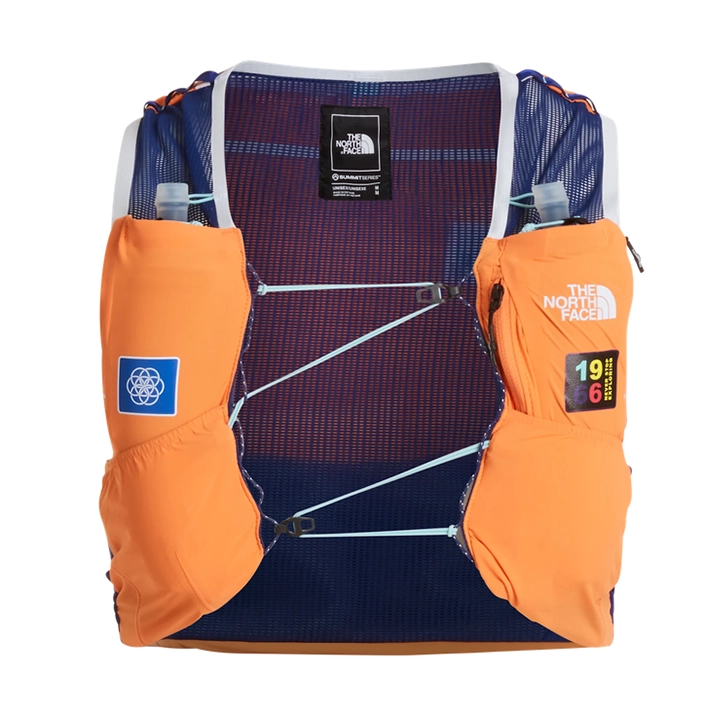
If your vest has a bladder compartment, a 1.5 litre hydration bladder gives you range on stretches without fountains. For poles you will find the Leki Trail Running Quiver and the Salomon Custom Quiver Ultra, quivers that clip onto the vest, and the The North Face Run Pole pocket, compatible with the Summit Run Vests.
-
Hydration Bladder 1.5 Liter
Original price was: 35,00€.28,00€Current price is: 28,00€. VAT included -
Trail Running Quiver
Original price was: 40,00€.36,00€Current price is: 36,00€. VAT included -

Custom Quiver Ultra
-
Tasca Run Pole
Original price was: 26,00€.24,00€Current price is: 24,00€. VAT included


You will find every model, with up-to-date sizes and availability, in the Backpacks category of our shop.
Test it the way you will really use it
Do not wait until race day to use a new vest. Try it in training with the same flasks, the same food and at least part of the kit you will carry. After 30 minutes and after two hours, check for chafing, whether the flasks slip down in their pockets, whether your phone is within reach and whether you can take your jacket off without stopping for too long.
Every outing also helps you find your own system: gels on the right, salts on the left, jacket in the back pocket, rubbish in a separate compartment. It is a routine that saves energy and attention when the terrain gets technical or fatigue sets in.
A vest chosen with care is not a container to fill, but a piece of kit that supports your pace and your self-sufficiency. If you are torn between two capacities or two fits, drop by our shop in San Vendemiano or Pordenone with your usual kit: ten minutes of trying it on with full flasks and a jacket packed will tell you more than any comparison on paper.