 ITA
 DEU
 FRA
 ESP



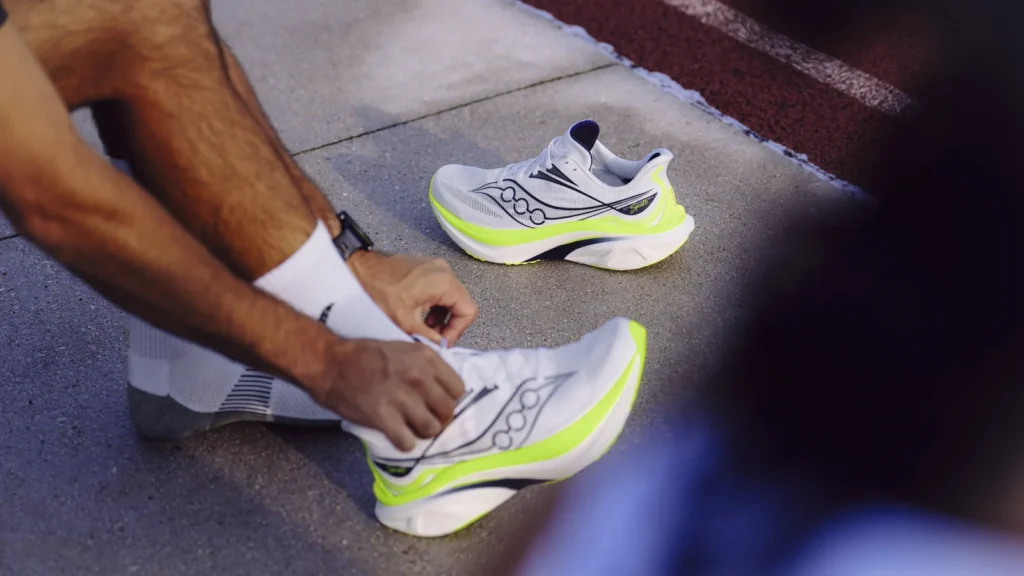
The Endorphin Speed is the shoe that made training in a plate normal: not a race shoe to keep in the closet, but a fast trainer to use every week. With the sixth version, Saucony changes the foam, redesigns the nylon plate and raises the midsole slightly. According to the first international tests, the result is a Speed that is more responsive and more stable than the 5, but also firmer.
We haven’t run in it yet: this review brings together what Saucony claims and what testers who have used it for weeks report, to help you work out whether it is right for you. You can already find it in our shop, in the men’s and women’s versions.
Contents
- The idea behind the Endorphin Speed 6
- Technical specifications
- Key technologies
- Comfort and fit
- How it runs
- Who it is for and who it isn’t
- Endorphin Speed 6 or Speed 5?
- How it handles different workouts
- Pros and cons
- Price and availability
- Is it worth it?
The idea behind the Endorphin Speed 6
In Saucony’s Endorphin family, every shoe has a specific job. The Pro and the Elite are the carbon-plated race shoes. The Azura and the Trainer are the unplated trainers. The Speed sits in the middle: it has the same PEBA foam as the race shoes, but a nylon plate, more forgiving than carbon, which keeps it usable even when your legs are tired.
The last two versions had moved the Speed towards comfort: softer, better suited to easy miles. The Speed 6 goes the other way. Several testers describe it as a return to its roots: a shoe for quality sessions, long runs at pace and, for many amateur runners, racing too.
Technical specifications
| Feature | Saucony Endorphin Speed 6 |
|---|---|
| Category | Plated speed trainer, neutral |
| Midsole | PWRRUN PBX (PEBA foam) |
| Plate | Nylon, redesigned, with side wings |
| Geometry | SpeedRoll (rocker) |
| Stack height | 38 mm heel / 30 mm forefoot |
| Drop | 8 mm |
| Men’s weight | 233 g (US 9) |
| Women’s weight | 198 g |
| Upper | Lightweight, breathable engineered mesh, gusseted tongue |
| Outsole | Rubber at forefoot and heel, cut-outs at midfoot |
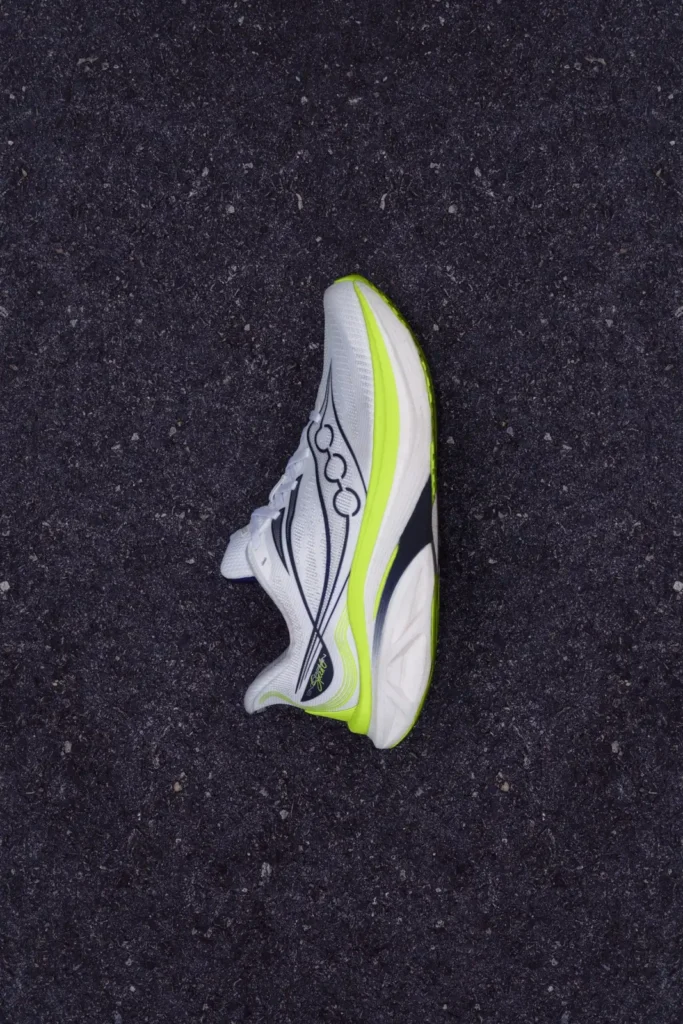
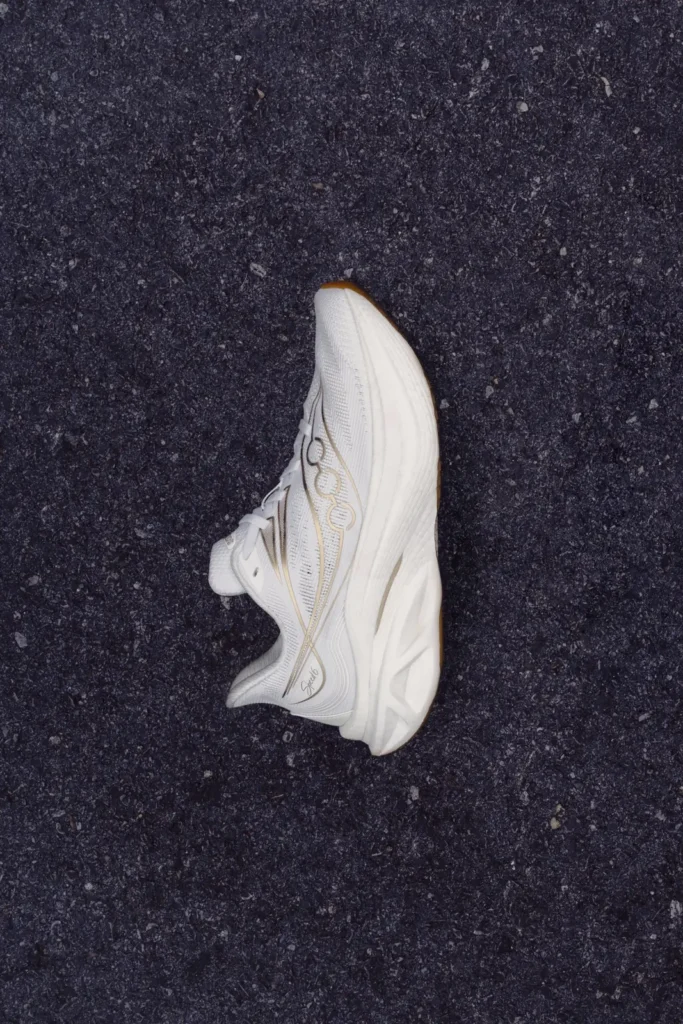
| Colourways | Men’s Black/White and White/Citron, women’s Yarrow/Silver |
Key technologies
- PWRRUN PBX foam. This is the evolution of the Speed 5’s PWRRUN PB: still expanded PEBA beads, but with a new formulation. Saucony presents it as lighter and softer, with the same energy return. On “lighter” the tests agree; on “softer” they don’t: almost every tester describes it as denser and snappier than the previous version. This is the point where it is worth forming your own opinion.
- Redesigned nylon plate. It runs the full length of the shoe and now has wings at the sides of the midfoot, visible on the midsole. They add some lateral guidance: the Speed 6 is still a neutral shoe, but it is more stable than the 5. Nylon is more flexible than carbon, so the toe-off is more progressive and less “harsh” than in a race shoe.
- SpeedRoll geometry. The rocker carries the foot from landing to toe-off. On the Speed 6 the forefoot pivot point is more pronounced: at faster paces the transition is quick and smooth, at slow paces you notice it more.
- 2 mm more foam. The stack goes from 36/28 mm to 38/30 mm, with the drop unchanged at 8 mm. More material underfoot for long runs, without changing the geometry Speed fans are used to.
Comfort and fit
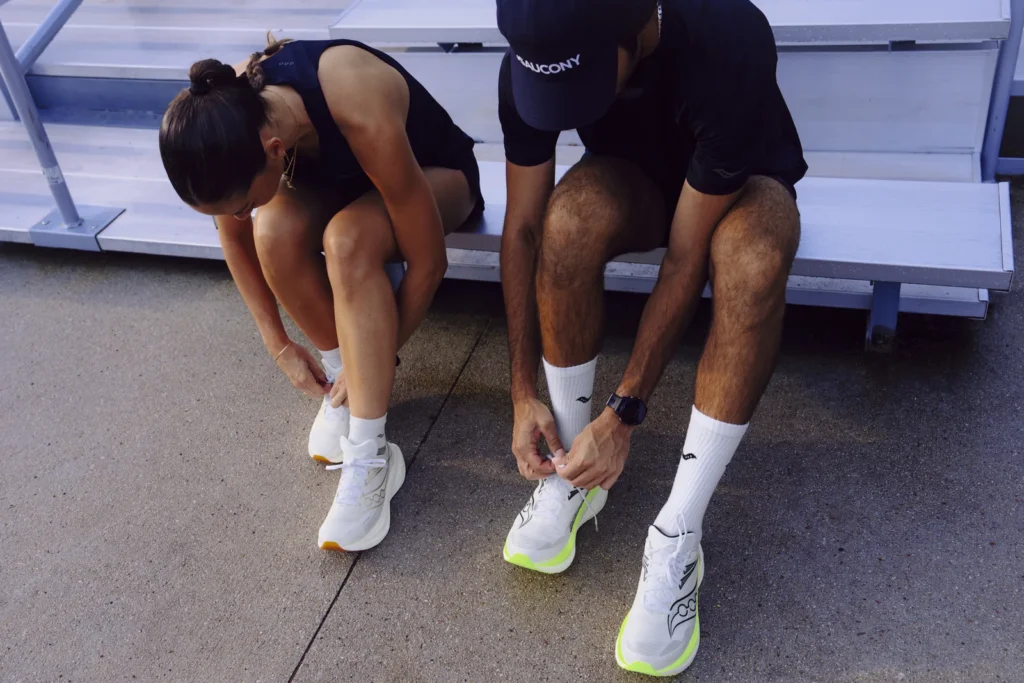
The Speed 6 fits true to size in length: if you wore your usual size in the Speed 5, you can stay with it. On its website, Saucony recommends going half a size up in performance shoes compared with everyday shoes: it is worth trying both.
On width, testers don’t all agree. For some, the forefoot is roomier than on the Speed 5; for others, the toe box tapers and the toe reinforcement makes it feel short for the first few days, until the upper settles in. The midfoot wraps well thanks to the gusseted tongue, and the heel holds securely. It is a fit designed for normal or narrow feet.
Two practical notes: the mesh is light and very breathable, but it can feel a little rough inside, so it is better not to wear it without socks. Some testers had hot spots on long runs, solved with thin technical socks.
How it runs

The word that comes up in almost every review is responsive. The foam is denser than on the Speed 5 and the plate does more work: when you pick up the pace, the shoe answers with a quick toe-off and a fast roll through the forefoot. Those who have run in both describe the Speed 5 as softer and more “yielding” by comparison.
The flip side shows at slow paces. Below a certain pace the Speed 6 is stiff and a bit wooden: several testers advise against it for recovery runs and keep it for quality days. Some still find it pleasant on easy runs, so a lot depends on your weight and footstrike. On long runs, though, the verdict is positive: it takes a few kilometres for the foam to “wake up”, then the rocker does its job and the pace holds with little effort.
Stability has improved: the base is wider at the midfoot and heel, and the plate wings keep the foot centred even when your legs get tired.
In a nutshell: the Speed 5 forgave everything, the Speed 6 rewards those who push.
Who it is for and who it isn’t
It’s for you if:
- you want a single plated shoe for intervals, tempo runs, progression runs and long runs at pace;
- you are preparing your first half or full marathon and want an affordable race shoe, less extreme than a carbon one;
- you have normal or narrow feet and like a snug fit;
- you want a bit more stability without moving to a support shoe;
- you use a rotation: the Speed 6 for fast days, a soft shoe for easy days.
It’s not for you if:
- you want a soft shoe for easy runs and recovery: in that case look at the Endorphin Azura or a cushioned shoe without a plate;
- you want the most aggressive shoe for flat-out 5 and 10 km races: here the carbon plate of an Endorphin Pro or Elite performs better;
- you run on gravel and trails: the outsole cut-outs pick up small stones;
- you have wide feet and need firm medial support;
- you like running without socks.
Endorphin Speed 6 or Speed 5?
| Feature | Endorphin Speed 6 | Endorphin Speed 5 |
|---|---|---|
| Foam | PWRRUN PBX | PWRRUN PB |
| Plate | Nylon, redesigned with side wings | Nylon |
| Stack (heel / forefoot) | 38 / 30 mm | 36 / 28 mm |
| Drop | 8 mm | 8 mm |
| Men’s weight | 233 g | 237 g |
| Feel | Denser and more responsive | Softer and more accommodating |
| Slow paces | Less suited | More versatile |
| Stability | Higher | Neutral |
On paper the jump looks small: two millimetres and four grams. On the run it isn’t. The Speed 6 is a faster, more precise shoe; the Speed 5 is easier and better suited to relaxed runs as well.
If you liked the Speed 5 precisely because it was soft, try the 6 before you buy it. If instead it felt too “mushy” for workouts, the 6 is the version you were waiting for. And if you want to save money, the men’s Speed 5 and the women’s Speed 5 are still available in our shops in San Vendemiano and Pordenone (Italy) and online at miomiorun.com, in some sizes and colourways at a discounted price. Here you can find our Endorphin Speed 5 review.
Compared with its closest rivals, such as the adidas Adizero Evo SL, the Speed 6 is denser, more stable and more responsive at high speed; the Evo SL is softer, has a wider toe box and works better at slow paces.
How it handles different workouts

- Intervals and repeats: this is its home ground. Quick transitions and a ready toe-off through the forefoot. For very short repeats and all-out 5 km efforts, though, some testers prefer a race shoe.
- Tempo, threshold and progression runs: its strongest point according to almost every review. It holds the pace naturally and doesn’t fall apart when your legs get tired.
- Long runs at pace: a pass. The extra 2 mm of foam shows in the second half, and the rocker helps you keep your cadence.
- Hills and hill repeats: the rocker and the plate help you stay on your forefoot.
- Easy runs and recovery: its weak point. It is stiff and not very accommodating; a softer shoe is a better choice.
- Racing: a solid option from 10 km to the marathon for many amateur runners, at a lower price than carbon-plated shoes.
- Wet conditions: opinions are split. Some testers find grip on wet asphalt improved over previous versions, others find it slippery in the rain and on tight corners. Caution is advisable.
Pros and cons
Pros
- Responsive foam and a plate that really performs at faster paces
- More stable than the Speed 5, with the foot well centred
- More cushioning for long runs and a few grams less
- Light and very breathable upper
Cons
- Stiff at slow paces: not an everyday shoe like the 5
- Thin rubber on the heel: some testers saw early wear
- The outsole cut-outs pick up small stones
- Upper a little rough inside, best worn with socks
- Mixed opinions on wet grip
Price and availability
In the United States the Endorphin Speed 6 was released on 15 October 2026 at 180 dollars, 10 more than the Speed 5. In our online shop it costs €200, for both the men’s and the women’s version.
The men’s version comes in sizes EU 42 to 46.5, in Black/White and White/Citron; the women’s version in sizes EU 37 to 41, in Yarrow/Silver. If you want to try it and compare it with the Speed 5 or the other Endorphin models, come and see us in our shops in San Vendemiano and Pordenone (Italy), or order it online at miomiorun.com.
Is it worth it?
If you are looking for a plated shoe to train hard without spending as much as a carbon race shoe, yes: the Speed 6 is the fastest and most precise Speed in years. If instead you need one shoe for everything, easy runs included, the Speed 5 was more accommodating, and the 6 works better paired with a soft shoe. You can feel the difference between the two in a few strides: come to one of our shops, try them one after the other and choose with your own legs.